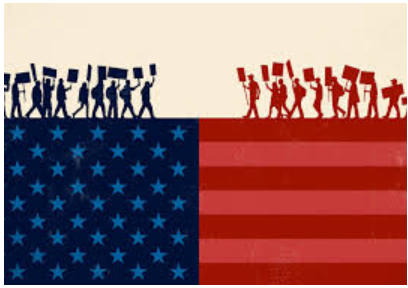
The title “The United States of America” is contradicted by the vast amount of political division within the country. A country that stands for freedom and unity is torn by one fatal flaw: politics. A negative connotation is assumed no matter which political party you fall under. But when did this division begin? Was it always meant to be this way?
The answer is no, the initial intent for the United States was not to be politically divided. This anti-division belief was owned by the Founding Fathers. According to History, “[…] in 1787, when delegates to the Constitutional Convention gathered in Philadelphia to hash out the foundations of their new government, they entirely omitted political parties from the new nation’s founding document.”
Because the Founding Fathers had seen the impact that political parties had on England, they did not want to introduce them to the new country of America. History says, “The framers of the new Constitution desperately wanted to avoid the divisions that had ripped England apart in the bloody civil wars of the 17th century.”
The Founding Fathers created the documentation we have built our country centered around: The Constitution, Declaration of Independence, and Articles of Confederation; yet the aspect of political unity that current day America lacks is what is separating it. We are currently seeing the impact of this with the tension between the two most prominent political parties in the United States: Democrats and Republicans.
George Washington—America’s first president and the man glorified enough to be on not one, but two forms of currency in the United States—was a believer that there should not be political parties. Mount Vernon says, “His [Washington] thought, in what became known as the Farewell Address in 1796, is clear: ‘the spirit of party’ ‘serves always to distract the public councils and enfeeble the public administration. It agitates the community with ill-founded jealousies and false alarms, kindles the animosity of one part against another, foments occasionally riot and insurrection.”’
The United States was not always as politically divided as it is now. The political polarization increased in more recent years. According to Court House News, “Researchers found that political polarization was largely flat through the 1990s and early 2000s, then began to climb steadily after 2008, the year of the global financial crisis, Barack Obama’s election and the rapid spread of smartphones and social media.”
The media has shown to be very influential in dividing people. Now, political parties have their own TikTok accounts and presences on various forms of media. Not only that, but their marketing teams constantly are producing political propaganda online, hoping to persuade the minds of voters and a very crucial group: the youth. In order to win over the next generation of voters, having a social media presence is a tactical approach. When the hatred for the opposing political party is planted in a young person’s brain, it is likely to gradually grow, resulting in a wider political divide for the new age of American adults.
Donald Trump and Kamala Harris’s social
media accounts.
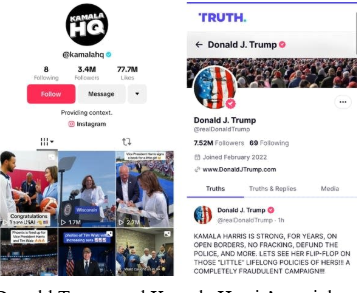
Image credits to MPR News
A survey was conducted on Apr. 9 and Apr. 10 where 13 Kennard-Dale High School students were provided with inquiries regarding political division. In the survey, students were asked, “If you are on social media, do political things show up on your For You Page?”, to which only three students (23.1%) responded with “No, not at all”. Five students (38.5%) selected “Yes, a lot” and the other five students said “Sometimes, but not often”. The ages of the survey participants range from 14 to 18, with the majority of the students being 16. Only two of the surveyed students are of age to vote, yet most of them are being or have been fed politically driven posts online.
Political beliefs do not just disunify the country; They can even sever relationships, friendships, and families. Two people joined in love can be separated by the silly concept of politics. According to Independent Women, “A nationwide 2017 Wakefield Research survey of 1,000 adults found that 10% of couples (married or dating) have split over political disagreements, rising to 22% among millennials.”
With the political polarization in the United States only increasing, the consequences of it are only becoming more and more dangerous. Being a political figure means knowing that at any time, an angry citizen could decide they disagree with you and —in extreme cases— make you pay the ultimate price for it. Johns Hopkins University found that, “The number of threats against elected officials has been skyrocketing. We know this because the Capitol Police said that in 2024, they had more threats against members of Congress than ever before.”
Not only are political figures at risk of political violence, but so are their followers. Voicing an opinion can be fatal, no matter what that political opinion is. Charlie Kirk, a known Republican activist, is an example of this. Kirk debated people from the opposing political party often. Kirk was shot at one of his debates at Utah Valley University on Sept. 10 2025. Because of Kirk’s political views, he was killed. This violent act was driven by the horrors of political divide.
Political violence goes both ways. About one year ago, Mellissa Hortman (House Democratic-Farmer-Labor caucus leader) and her husband were murdered in a politically motivated crime. Not only were Mrs. and Mr. Hortman assassinated, but there was another attack targeting the Democratic Senator John Hoffman, Yvette Hoffman, and their daughter, Hope Hoffman. The United States Attorney’s Office found, “‘Political violence has no place in our society and Boelter will be held accountable for his crimes. Today’s indictment reflects the tireless efforts of the dedicated professionals who work every day to protect our communities,’ said Brooklyn Park Police Chief Mark Bruley.”
When does the division stop? Will it ever stop? Both of these are questions no one truly knows the answers to. How many more families must be torn apart by politics? How many more relationships built around love will be torn by hatred? How many more lives must end before we deem political division a worthy enough issue to be fought? More and more questions one can only imagine the answers to. It can only be hoped, for the sake of our country, that unity in the United States is restored.